
Floyd County Warrant Searches
Start at Iowa Courts Online, the free public index that needs no subscription. Enter a name, case ID, or citation number and pick Floyd County. Don't stop at the case title; read the full event history, where an issue entry may be followed by service, return, an appearance, or a recall. For docket, document, court-date, and payment questions, call the Floyd County Clerk at 641-228-7777. For help confirming an active Floyd County warrant or a service question, call the Floyd County Sheriff at 641-228-1821. One system sits beyond public reach: the IOWA System serves eligible criminal-justice agencies only, not self-search.
- Gather the full name and case or citation number if known.
- Search the Iowa public docket and choose Floyd County.
- Review event dates and public document access.
- Ask the Clerk what the docket means and which court controls the next step.
- Ask the Sheriff how current warrant status can be confirmed safely.
Inside Iowa Courts Online
The state interface splits broad name research from an exact case or citation lookup. Its payment tool carries some useful case-location fields too. It is not, though, a live active-warrant list for Floyd County or anyone else. A warrant event shows up only when that event and its access level allow public display. The official blank By Name form lays out the search route without exposing any private person.
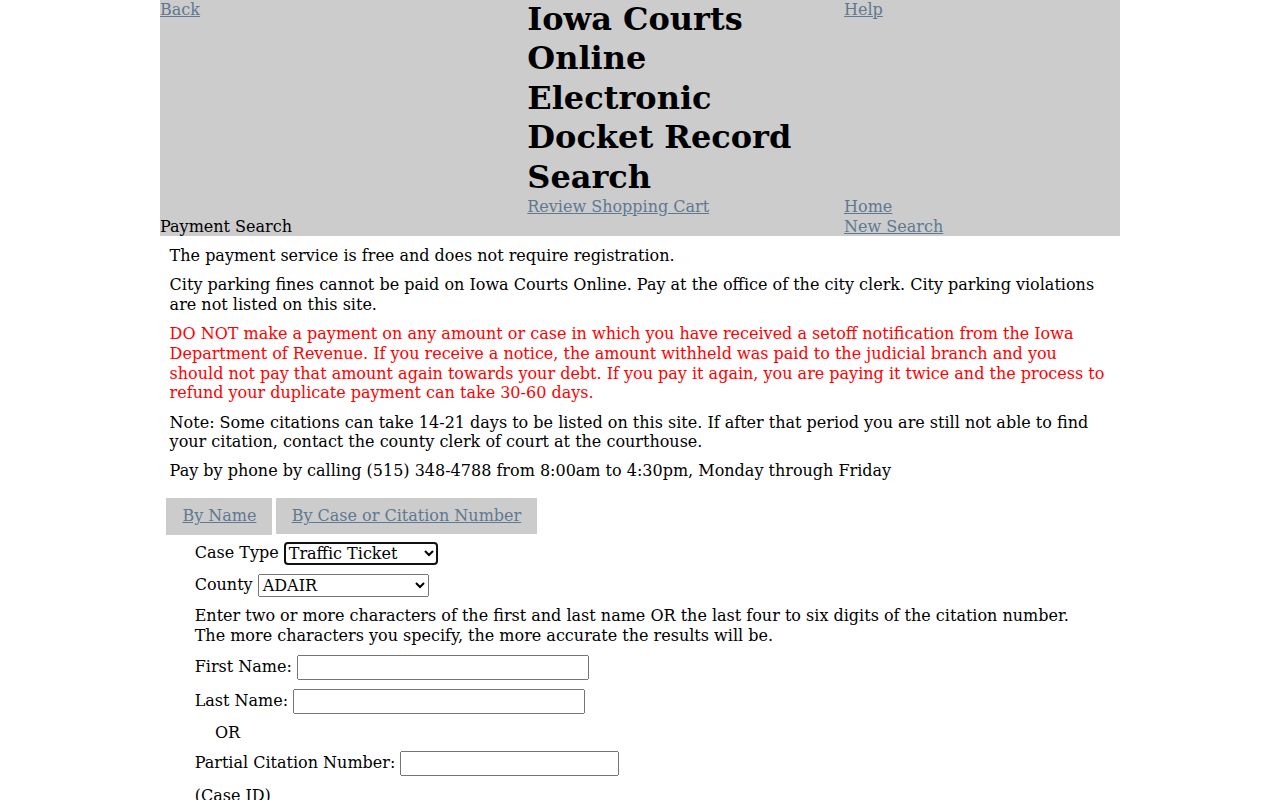
Treat any result as a pointer. It points to the case record, and Floyd County officials confirm the current status.
What a Warrant Search Asks For
The By Name screen takes a first and last name, plus an optional partial citation number or case ID. Iowa Courts Online recommends two or more name characters, or the last four to six citation digits. More characters, better accuracy. The By Case or Citation screen wants the full identifier and lets you choose the county, which matters for a Floyd County search.
| Field | Format | Search use |
|---|---|---|
| First name | At least two characters | Broad name match |
| Last name | At least two characters | Required with first name guidance |
| Partial citation or case ID | Last four to six citation digits may help | Narrows a name match |
| Case ID or citation | Full identifier on precise form | Direct case route |
| County | Select Floyd | Controls filing location |
A city name alone may miss a District Court case. Search the filing county instead. Nora Springs matters can even raise a cross-county question in Floyd County.
Floyd County Name-Match Traps
A similar name identifies no one. Public results can mix several cases, or several people, under one spelling. Check the county, case type, citation or case number, and dates before drawing any conclusion. Don't share another person's result or build a profile from court entries. The proper use is understanding your own record, or helping a relative in Floyd County with their consent.
Key caution: “Case found” does not mean “active warrant confirmed,” and “no case found” does not prove that no warrant exists.
Records can be new, restricted, sealed, juvenile, or parked in another system entirely. A warrant already served or recalled may still sit on the docket as history. The Floyd County Clerk can explain public court entries. The Sheriff handles active county warrant and service routing.
Floyd County Warrant Search Results
A Floyd County warrant search result can carry a lot of detail: case ID, case type, filing date, the charge, hearing dates, a failure-to-appear event, a warrant event, a return, an initial appearance, bond conditions, payment entries, a recall, or the next hearing. Some results show only part of that. Not every field appears, and not every document behind the record is open to the public.
| Case ID | The court file reference, represented here as CR-0000-XX |
|---|---|
| Warrant event | An issue or filing entry, not automatic proof of active status |
| Return | A later service or execution filing when public |
| Bond or release | Terms set for the case, subject to judicial review |
| Recall or disposition | A later event that may change the warrant's status |
| Access flag | A sign that a document is restricted or limited |
Read the timeline, not just one line. The newest entry may explain an old warrant event, but direct confirmation from Floyd County is still the safe last step.
When Floyd County Citations Lag
Iowa Courts Online warns that citations can take 14 to 21 days to appear. That lag is only a posting caveat. It does not mean the citation, or any duty tied to it, is gone. Once the window passes, call the Floyd County Clerk with the citation details. City parking is a separate track: the Iowa public court payment system does not list or accept city parking violations, so ask the relevant city clerk. Court-filed traffic citations, missed court dates, and payment events stay with the Clerk and Iowa Courts Online. And never assume paying court debt recalls a warrant. Payment, a payment plan, a license effect, and warrant status can be connected yet remain separate official actions. Ask the Clerk what the issuing court requires.
Floyd County Warrants: Who Holds What
Floyd County runs one unified Iowa District Court. No separate city criminal courts exist. The Clerk keeps District Court dockets and public court files. The Sheriff serves and maintains active Floyd County arrest warrants. Charles City and Nora Springs police can route local police-record questions. Rockford, Rudd, Floyd, and the rural areas lean on the county-Sheriff model that the official pages document.
| Channel | Best use | Limit |
|---|---|---|
| Iowa Courts Online | Public docket and payment search | Not live enforcement status |
| Floyd County Clerk | Case, document, date, and court instructions | Does not serve warrants |
| Floyd County Sheriff | Active county warrant and service routing | No public online roster found |
| City office or police | Police records or city parking | Does not replace District Court Clerk |
| PACER or U.S. Marshals | Known federal matter | Not a state warrant channel |
The Restricted Iowa Warrant Layer
The IOWA System, short for Iowa On-line Warrants & Articles, links eligible criminal-justice agencies to wanted-person and related records. It also ties into national systems. There is no public registration or public warrant-search form. The Iowa Judicial Branch forms and orders index publishes the official warrant-form source.
Blank legal forms show which fields a warrant can carry. They open no live IOWA System entries and no private Floyd County records.
Which Warrants Stay Restricted
Access depends on document type and case stage. Iowa's restricted-document guide keeps arrest-warrant applications, orders, and supporting information closed before execution, return, or initial appearance. After that named event, a related order may become public unless a Floyd County court orders otherwise.
- WABE
- A bench-warrant document limited to registered parties, attorneys, clerks, and judges.
- WAJB
- A juvenile bench warrant restricted to court and official users.
- Sealed
- Kept from public view by law or court order.
- Public docket
- The index of public events, which may not expose each filed document.
A strong records request names the office, the record type, a case or citation number when known, the date range, and your preferred format. The Floyd County Clerk keeps District Court dockets and court papers. Administrative, maintenance, or service records sit with the Sheriff. A single broad request sent through the county website tends to route slowly. It does not bypass a court restriction. Public access in Floyd County can shift with the case stage. An application kept from view before execution stays sealed even if someone demands it under the open-records law. After execution, return, or initial appearance, an order may become public. Another rule or court order can still block it. A Floyd County docket can show that an event took place while its document stays sealed. Iowa Code chapter 22 does not override these rules. Ask the Clerk about a public copy, a courthouse terminal, or another access method. That beats any unofficial mirror site. If an item is withheld or redacted, ask the custodian to name the access basis.
Floyd County Bond Search Limits
A search result may show bond or release terms. It cannot predict the judge's next move. Iowa's uniform bond schedule gives general guidance for specified arrests when courts are not in session. Once a judicial officer reviews the person, Iowa Code section 811.2 controls. The schedule is not binding then. The official uniform bond schedule page shows the general figures.
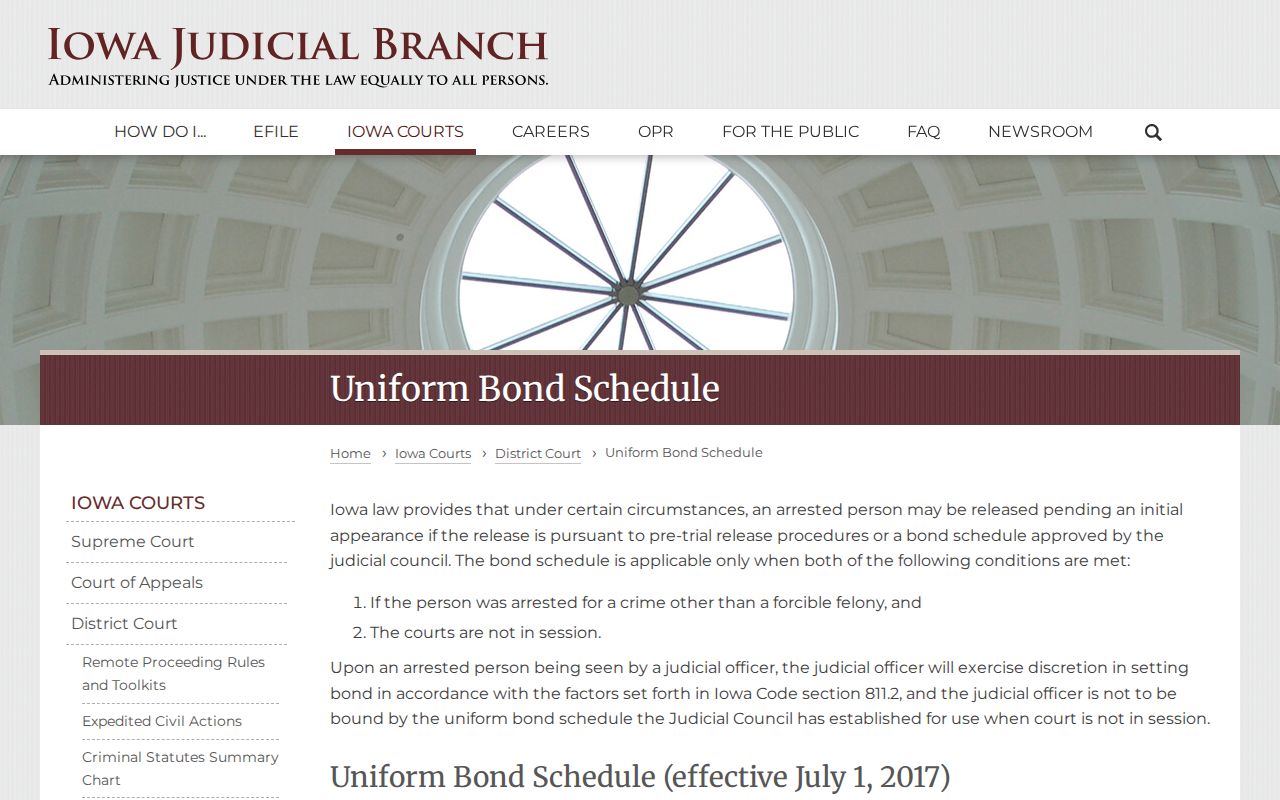
No amount in that schedule is a Floyd County warrant-clearing fee. The Sheriff fee page lists $35 for a warrant. That line covers service process only. It is not a universal recall price. Release after judicial review can mean personal recognizance, an unsecured appearance bond, supervision, travel limits, surety, cash, or other conditions. The court weighs the charge, appearance risk, resources, ties, and the safety factors listed by law. No public search can predict that call. Ask the Clerk for recorded terms and an attorney for case-specific advice.