
Rudd Warrant Checks
Rudd has no city warrant list, police page, or municipal criminal court portal, so any warrant check goes through county and court channels. Before you call, gather the full name and any case or citation number printed on your own paperwork. Keep private identity documents away from informal email and private websites.
- Use Iowa Courts Online to look for an available Floyd County docket or case event.
- Ask the Floyd County Clerk at 641-228-7777 about the issuing court, public documents, court date, or case status shown in the docket.
- Ask the Floyd County Sheriff at 641-228-1821 whether a county warrant is currently maintained for service and how to direct a records inquiry.
- Call Rudd City Hall at 641-395-2760 for municipal administration, local ordinance routing, or city parking, not for District Court warrant confirmation.
- Consult a lawyer before arranging an appearance, surrender, or bond. Confirm any later recall with the court and Sheriff.
Rudd Warrant Routing Starts With the Record Type
Where you live does not decide who keeps the record. A Rudd parking issue may stay in the municipal lane with the city. A municipal infraction, traffic citation, simple misdemeanor, or criminal charge filed with Iowa District Court belongs to the court lane. Any question about active arrest-warrant service goes to the Sheriff.
Rudd City HallMunicipal administration, city contacts, ordinance routing, and parking questions., Floyd County ClerkDistrict Court docket, public court documents, case events, and appearance questions., Floyd County SheriffCounty law enforcement and current active-warrant service confirmation., Iowa Courts OnlinePublic docket and payment tool, not a live active-warrant list.
Policing and Courts in Rudd
Law enforcement in Rudd runs through the county. The Floyd County Sheriff places the town within county and rural coverage, including contract services, and posts no separate Rudd police warrant desk. Deputies answer calls, investigate, and serve warrants. A judicial officer, not the Sheriff, decides whether a warrant issues in the first place. Iowa's court setup also gives Rudd no municipal criminal court of its own. Judicial magistrates handle simple misdemeanors, traffic matters, county and municipal infractions, preliminary hearings, and search-warrant proceedings, while district associate judges and district judges take the criminal cases assigned to them. Once a Rudd case is filed in Floyd County, the Clerk of the District Court keeps the court record from there.
Rudd Warrant City Hall Hours Matter
Rudd City Hall sits at 402 Chickasaw Street, Rudd, Iowa 50471. The city lists phone 641-395-2760 and fax 641-395-2690. Office hours run Monday through Thursday, 8 a.m. to 2 p.m. That is a short window, so a call ahead is smart before you drive over. It also helps sort out quickly whether your matter is city parking, general municipal administration, or a court-filed case that belongs elsewhere.
Counter distinction: Rudd's city clerk is not the Floyd County Clerk of Court and cannot be assumed to recall or confirm a District Court warrant.
In Charles City, the Floyd County Clerk works from 101 S Main Street, Suite 403. The Sheriff's office is in Suite G132, with a separate exterior entrance. A quick call to the right counter saves a wasted trip, since Rudd's own office hours are so limited.
Warrants in Rudd: The Main Types
Rudd warrants take their shape from the Iowa proceeding behind them. The city publishes no local classification system, and no local code or fee exists to look up.
| Type | Typical court path | Best first record route |
|---|---|---|
| Bench warrant | A missed required appearance or another court event | Floyd Clerk, then Sheriff for active service status |
| Arrest warrant | A complaint or charge followed by the required judicial finding | Iowa District Court and Floyd Sheriff |
| Traffic-related warrant | An unresolved court citation or missed traffic date | Iowa Courts Online and Clerk, then Sheriff |
| Municipal-infraction matter | A city-originated matter filed in unified District Court | Rudd for administration; Clerk for the court record |
Iowa sources speak of a bench warrant and an arrest warrant for failure to appear. No Texas-style capias pro fine process applies in Rudd.
No Rudd Warrant Portal or Fixed Fee
Rudd posts no police portal, no online city warrant list, and no city criminal-court page. Nothing official says Rudd City Hall takes warrant-clearance money either. The Sheriff's fee schedule does carry a line reading "WARRANT $35.00," but that is a service or process fee, not a bond, a fine, or a flat charge for clearing a criminal warrant. Never pay an unsolicited caller. The Iowa Judicial Branch warns that courts do not demand warrant payment by text or phone, ask for a Social Security number on such a call, or send anyone to prepaid cards, cryptocurrency, or unofficial websites. Law enforcement does not collect court fines. Check any claimed debt with the Clerk, using an official number you find yourself.
Rudd Warrant Records: What They Show
A public docket can show a case identifier, its type, a generic allegation, a filing date, a hearing, an order, a bond entry, a payment event, or a later return. Access rules and the case stage decide what appears. Arrest-warrant applications, some bench-warrant documents, sealed information, and juvenile matters may stay restricted even in a Rudd case.
| Case reference | An official identifier, represented safely here as [CASE-ID]. |
|---|---|
| County and case type | Floyd County plus the criminal, traffic, simple-misdemeanor, or municipal-infraction lane. |
| Court event | A filing, appearance, failure-to-appear event, warrant order, service return, or later disposition when public. |
| Issuing authority | The Iowa District Court judicial officer, not Rudd City Hall. |
| Bond or debt | Only the amount an actual court record states, with no assumed local fee. |
| Current status | A time-sensitive fact that needs Clerk or Sheriff confirmation. |
Rudd Warrant Traffic and FTA Steps
For a court traffic citation, Iowa Courts Online lets you search by name or by full case or citation number, with a county selection. Citations often take 14 to 21 days to show up. If yours still has not appeared after that window, call the Floyd County Clerk. City parking tickets are excluded from Iowa Courts Online, so route those straight to Rudd.
- Read the citation to see whether court appearance is required.
- Search with Floyd County selected and retain the official case or citation number.
- Ask the Clerk about a missed appearance, court debt, payment plan, or warrant event.
- Ask the Sheriff separately about present warrant service status.
In Rudd, settling a fine, joining a payment plan, and clearing a license block are separate steps from a recall. Only the issuing court's own act can resolve the warrant itself.
Rudd Warrants and Floyd County
Rudd's local model routes outward: Rudd municipal matter › Iowa District Court in Floyd County when filed › Floyd County Clerk for the court record › Floyd County Sheriff for service status. Eligible agencies may use the restricted IOWA System, but it is not a public statewide self-search tool.
Rudd sits inside a larger system, and the Floyd County warrant records page lays out how the county pieces fit together. For this town, the split is simple. City Hall handles local administrative and parking matters. The court and the Floyd County Sheriff hold the warrant lanes. Iowa law also allows an arrest warrant to be served in any county, so leaving Rudd does not weaken it.
Rudd Warrant Requests Should Name the Custodian
A public-record request works best when it names the record and goes to the office that actually holds it. Iowa Code chapter 22 opens most records to examination, subject to lawful exceptions, and court records also answer to Judicial Branch rules. A broad request mailed to Rudd cannot force City Hall to hand over a District Court record it never kept.
For the court file
Contact the Floyd County Clerk with the case number, record type, and useful date range.
For warrant service
Contact the Floyd County Sheriff and describe whether the question concerns current status or a public service record.
For city administration
Contact Rudd City Hall about its own administrative, ordinance, or parking records.
Before you send a Rudd records request, ask about formats, likely response time, and any lawful copying cost. Restricted material may be withheld or redacted.
Accessing Rudd Warrant Records
What you can see in Rudd depends on the record, its custodian, and any restrictions on it. A docket index may be public while the underlying warrant document stays restricted. Juvenile cases get added protection. Remember that a blank public result does not prove no warrant exists, and an old entry alone does not prove one is still active.
Key rules:
Iowa Code chapter 22 provides a right to examine public records subject to statutory limits.
Iowa Code section 804.4 authorizes delivery to a peace officer and service across Iowa counties.
Judicial Branch access guidance explains protected warrant materials and restricted case types.
Rudd Warrant Source Image
For contact details, the official Floyd County City of Rudd page lists the municipal address, phones, and hours. Use it to tell City Hall apart from the court and Sheriff routes.
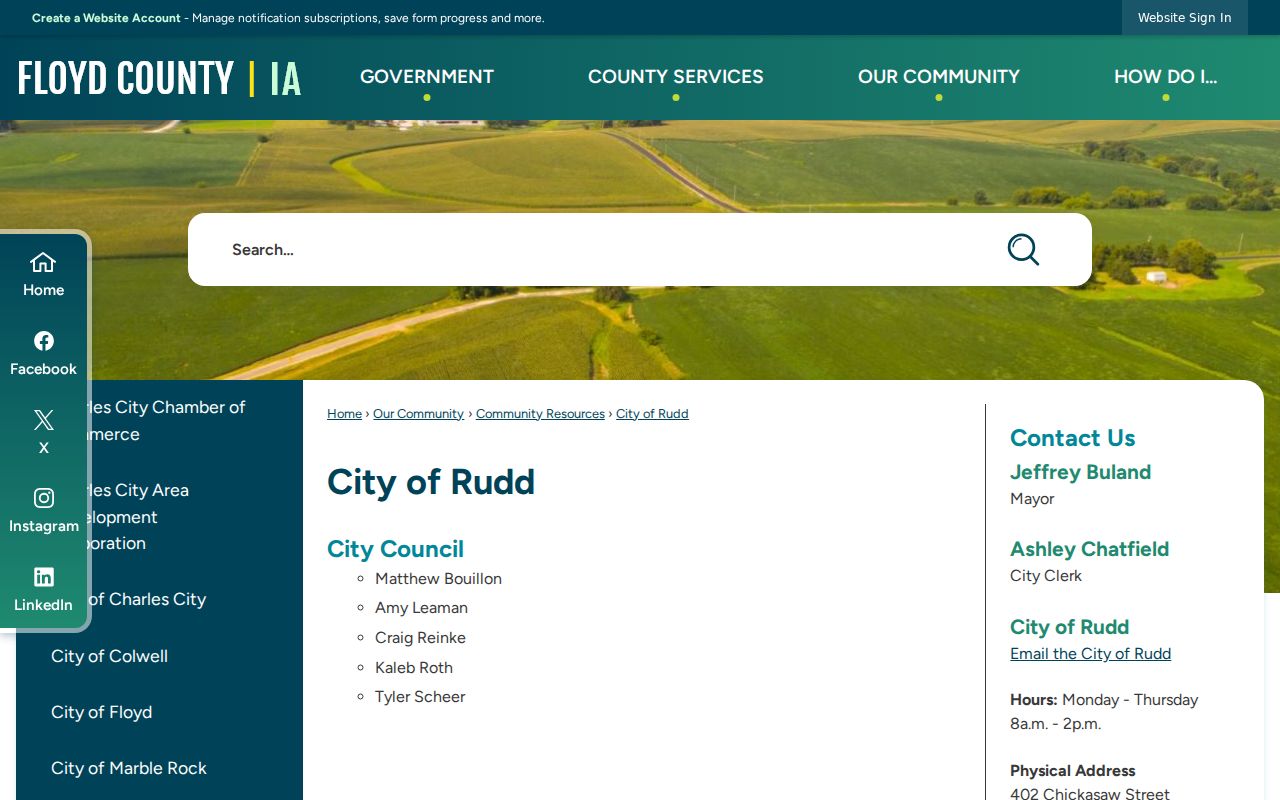
That listing is a city contact point only. It is not a criminal-warrant portal, a payment counter, or any list of people, and no Rudd warrant status comes from it.
Rudd Warrant Safety and Final Confirmation
Never confront someone or report a person based only on a matching name, a cached page, or an unofficial list. Do not post a private address, workplace, vehicle, family detail, or photograph either. Call 911 for immediate danger only. Routine self-checks and family record questions belong with the published offices, not with speculation. If a record may involve you, talk to a lawyer, confirm the issuing court with the Clerk, and ask the Sheriff where service stands. Then check again after any payment, appearance, bond, or court order. A docket change plus the Sheriff's word beats a receipt or a caller's promise. Rudd's small-office schedule rewards planning. City Hall keeps Monday through Thursday hours from 8 a.m. to 2 p.m., the Floyd County Clerk lists weekdays from 8 a.m. to 4:30 p.m., and the Sheriff's public office posts weekdays from 8:30 a.m. to 4 p.m. Those windows tell you when a counter is normally open, not that a judge, deputy, or particular record will be ready when you walk in. Call the office holding the record before you drive over from Rudd.
A traffic citation needs patience: Iowa Courts Online documents a 14-to-21-day posting window, so let that pass before you worry. Afterward, take the question to the Clerk about the court case rather than resending it to City Hall. Court parking tickets stay outside the online court payment system, so Rudd remains the right first call for that narrow local matter. On court debt, ask about official payment or plan options, but keep the warrant question separate from the money question. Only the court can act on recall, and the Sheriff can confirm the current service position. No Rudd office posts a public most-wanted or active-warrant roster. That gap spares readers stale names, but it settles nothing about one person's status. Use a properly scoped request, the official case route, and direct confirmation instead.