
Floyd County Warrant Checks
A solid Floyd County warrant check runs on two official lanes. Iowa Courts Online is the free starting point. Its public docket can show a case, hearing, payment item, or warrant-related event when the material is public, though it is not a live warrant database. The Floyd County Clerk of Court explains docket entries and which documents you can get. The Floyd County Sheriff serves active county arrest warrants and is the right office for current service-status questions. Bring a full name, plus a case or citation number if you have one, since a broad name query can match more than one person. Use what you find only for your own matter or to help a relative, and never publish a result. Follow this order:
- Search Iowa Courts Online by name or the full case or citation number, selecting Floyd County.
- Read docket events for issue, failure to appear, return, initial appearance, recall, or a new date.
- Call the Clerk at 641-228-7777 about the docket, public files, or court instructions.
- Call the Sheriff at 641-228-1821 to ask how to confirm current Floyd County warrant status.
- Use a city contact for police records or city parking, and federal sources only for a federal case.
Floyd County's Two-Counter Route
Both counters share a building but do very different work. The Floyd County Clerk of Court sits in Suite 403 at 101 S Main Street, Charles City, handling District Court dockets, criminal and traffic files, court fees, and public-document questions. Published hours are weekdays 8 a.m. to 4:30 p.m., and the phone is 641-228-7777. The Floyd County Sheriff works out of Suite G132, weekdays 8:30 a.m. to 4 p.m., at 641-228-1821. Public entry is the exterior right atrium door on the north Court Street side; there is no indoor path from the courthouse to that counter. Call before you travel. Ask which office should take your question. The official Clerk page shows the court contact and office context.
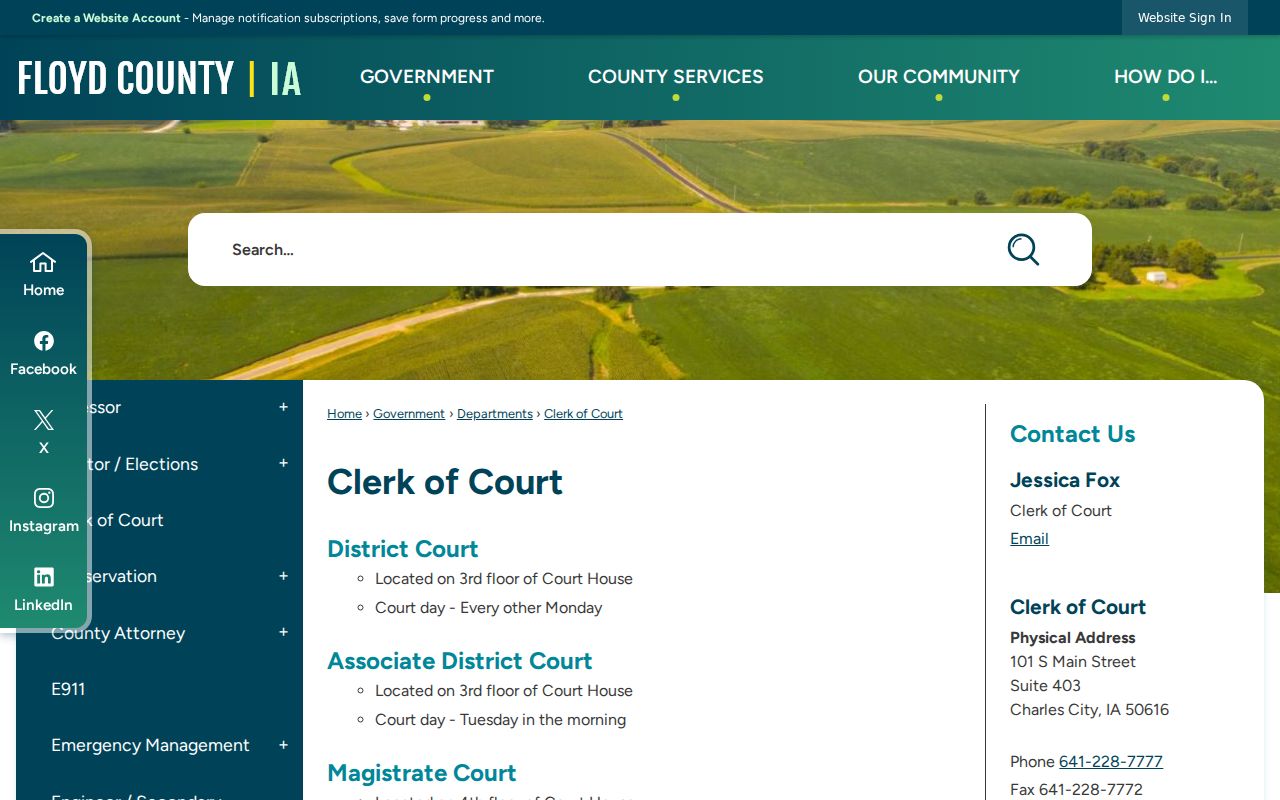
The Clerk holds the court records in Floyd County, while the Sheriff answers warrant service and status-routing questions.
Warrants in Floyd County: The Main Types
Floyd County warrant records come from Iowa District Court, not from a web of separate municipal criminal courts. A magistrate, district associate judge, or district judge can issue process within that officer's authority. The type tells you what a warrant authorizes, not whether it is still open today.
| Warrant type | How it arises | Who issues it |
|---|---|---|
| Arrest warrant | A complaint, indictment, or information supports custody. | An Iowa judicial officer |
| Bench warrant | A required court event is missed or a term is not met. | The judge or magistrate |
| Search warrant | A sworn application supports a specified search. | A magistrate or judge |
| FTA arrest warrant | A failure to appear triggers allowed case process. | The court |
Iowa sources say "bench warrant" or "arrest warrant for failure to appear." A Texas-style capias pro fine process has no place in Floyd County.
Floyd County Court Search Fields
The Iowa Courts Online payment search gives two routes. By Name takes first and last names, plus an optional partial citation number or case ID; the system wants at least two characters per name, or the last four to six citation digits. The exact route needs the full case ID or citation number and a county choice.
| Field | Use | Floyd County caution |
|---|---|---|
| Name | Broad index search | Common names may match several people |
| Case ID | Direct case route | Enter the full ID |
| Citation | Traffic lookup | New items can take 14 to 21 days |
| County | Filing location | Select Floyd |
| Case type | Narrows results | No “active warrant” field exists |
The official blank search interface supplies the fields pictured here.
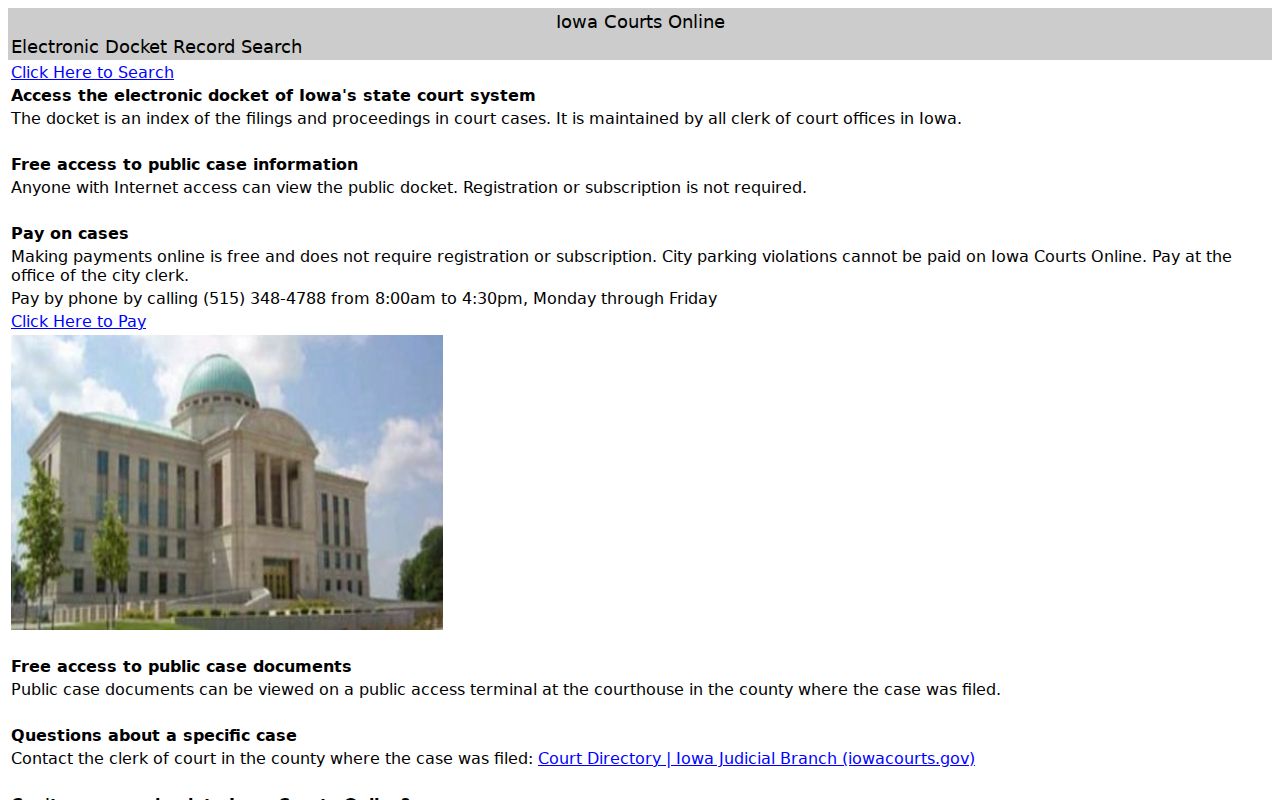
A matching Floyd County case is only a lead. It does not prove a current active warrant.
Floyd County Warrant Records: What They Show
Public Floyd County warrant records can combine warrant-form fields with later docket entries. Iowa Code section 804.2 requires identifying information or a general description, the offense, the date and place of issue, and the issuing magistrate's signature or office. A bailable warrant may carry a bail endorsement. Access can change after service or an initial appearance.
| Reference | A court identifier, shown safely as CR-0000-XX |
|---|---|
| Subject | Name or general description on official process |
| Offense | Charged offense or general description |
| Issuing court | Iowa District Court and judicial officer title |
| Bond or release | Case-specific terms when public |
| Docket events | Issue, return, appearance, recall, payment, or next hearing |
"Warrant event" does not mean "still outstanding." Look for a return, recall, cancellation, or later appearance, then confirm with the Floyd County Clerk or Sheriff.
Floyd County Has No Public Roster
The Floyd County Sheriff, jail, directory, alert, and linked county pages publish no searchable active-warrant or most-wanted roster. That is an access fact worth knowing. Do not fill the gap with an arrest aggregator, mugshot page, or commercial instant-record service.
Quick answer: An Iowa Courts Online result may show a warrant-related event, but only the proper court or Sheriff can confirm current Floyd County warrant status.
The official Sheriff information page says the office serves and maintains active Floyd County arrest warrants.
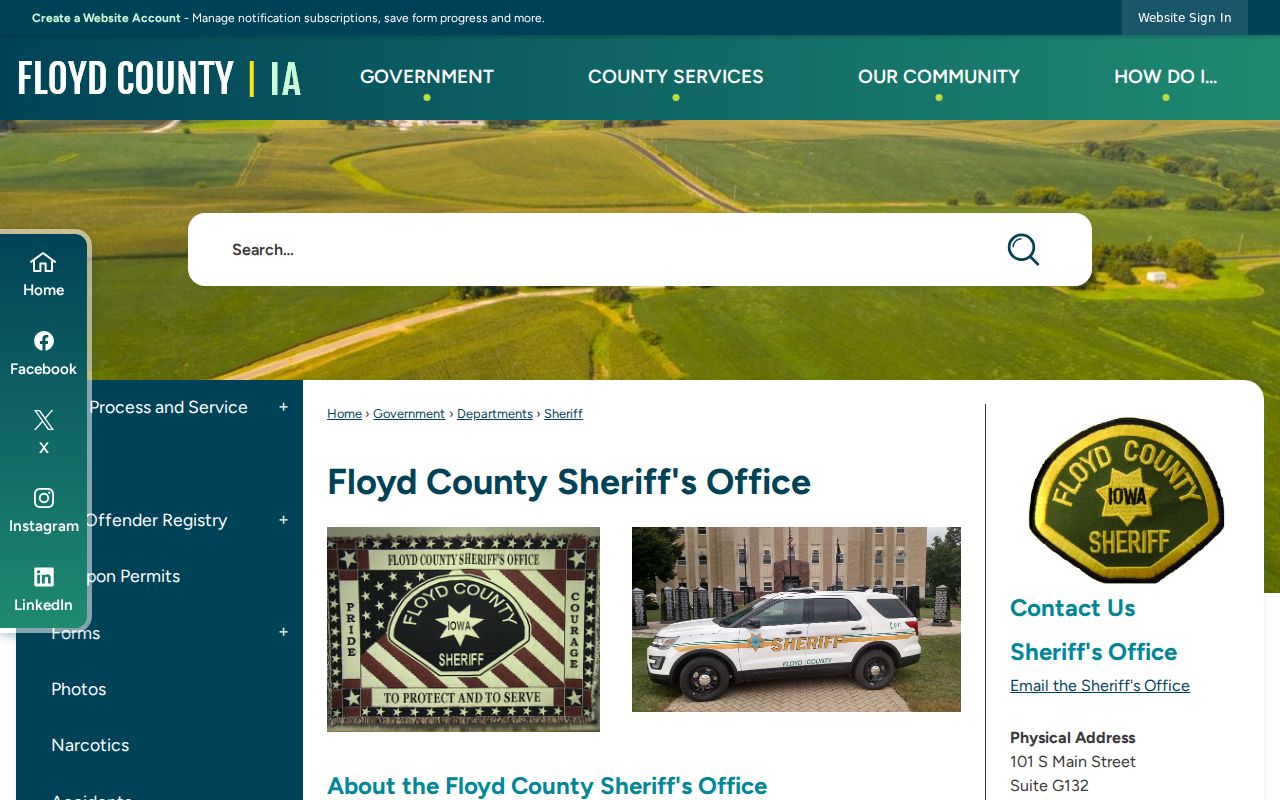
That page gives contact channels, not a name roster. A direct status question to the office is the honest fallback in Floyd County.
Floyd County Warrants: Who Issues, Who Serves
Iowa District Court is the unified trial court. Magistrates handle simple misdemeanors, traffic and municipal infractions, preliminary hearings, bail, and search-warrant proceedings. District associate judges add serious and aggravated misdemeanors and class D felonies, while district judges hold general authority. Police can investigate or start a citation, but only the court issues judicial process. A peace officer serves an Iowa arrest warrant, and Iowa Code section 804.4 allows service in any Iowa county, so a Floyd County warrant may be served elsewhere. Local officers and other state peace officers may act within their authority. The filing county still controls the court response.
Floyd County Sheriff
101 S Main Street, Suite G132
Charles City, IA 50616
641-228-1821
Floyd County Clerk of Court
101 S Main Street, Suite 403
Charles City, IA 50616
641-228-7777
Floyd County Status Is a Timeline
A warrant is not static. The useful sequence is: court issue → delivery to a peace officer → service or court response → return → appearance, recall, or another disposition. A public docket can lag an event, and a restricted law-enforcement entry can differ from public display. An old screen capture should never control a decision.
- Issued
- The court signed the warrant.
- Active
- No execution, recall, cancellation, or closure is recorded in the controlling system.
- Served
- A peace officer executed the process and made a return.
- Recalled or quashed
- The court withdrew or set aside the warrant.
- FTA
- Failure to appear at a required court event.
The restricted IOWA System may hold law-enforcement status, but the public cannot search it. Status questions go back to the Floyd County Clerk and Sheriff.
Handling a Floyd County Warrant
Found a Floyd County record that may concern you? Ask the Clerk which court and case are involved. Ask whether an appearance is required and whether counsel, bond, or another court-controlled step applies. The Sheriff answers a current service-status question, and asking is safer than guessing. An attorney can discuss voluntary surrender, release, bond, or a motion asking the court to recall or quash a bench warrant. Do not assume a payment erases a warrant. Court debt, a payment plan, a license consequence, and warrant status are related in some cases but are not the same record. The Floyd County judge controls recall and release terms. The statewide uniform bond schedule is only general guidance for set situations when court is not in session.
Important: Contact an attorney and the official Clerk or Sheriff before acting; only the court can set appearance, recall, bond, or release terms.
Floyd County Warrant Scam Signs
The Iowa Judicial Branch issued a June 2026 warning about callers who lean on jury service, fines, and arrest threats to demand money. Courts do not demand payment by phone or text. They never seek Social Security numbers, gift cards, cryptocurrency, wires, or an unofficial payment site during such calls. Law enforcement does not collect court fines. Hang up. Find the Floyd County Clerk number yourself. If a real debt exists, the Clerk, secure ePayment, or the official phone route handles it. The official Floyd court directory lists the verified contacts for Floyd County courts.
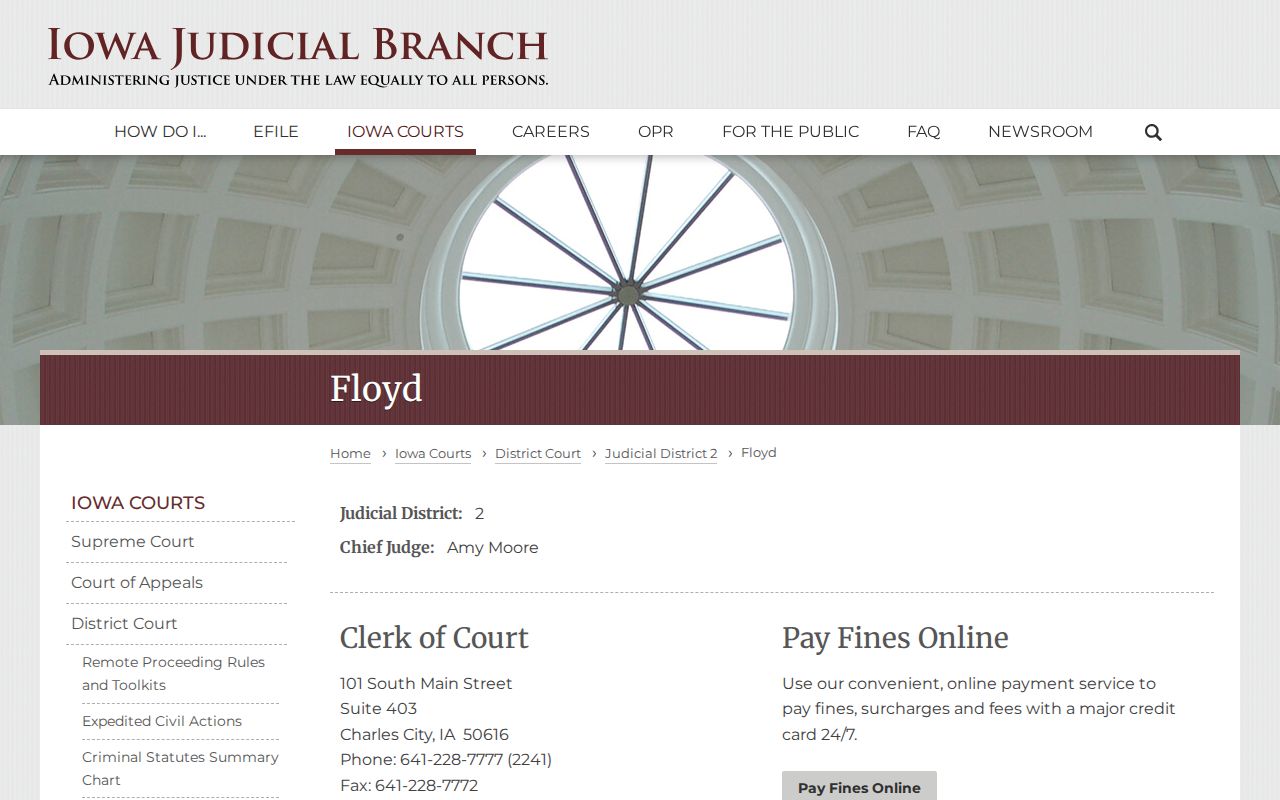
Use that source to reach the court instead of trusting an incoming demand.
Warrant Record Access Under Iowa Law
Iowa Code chapter 22 opens public records to examination. Court rules and confidentiality laws still apply, so ask the right office for a precise item and date range. The Floyd County Clerk holds court files. The Sheriff holds its own service material, and a lawful custodian may redact or withhold restricted information.
Key rules:
Iowa Code §804.2 states arrest-warrant content requirements.
Iowa Code §804.4 permits service in any Iowa county.
Iowa Code chapter 22 supplies the public-record framework, subject to other limits.
Unexecuted applications and their supporting facts can be restricted in Floyd County. A bench-warrant document marked WABE is generally limited to registered parties, attorneys, clerks, and judges, and juvenile material faces tighter limits.
Floyd County City Routing
Location sets the first police contact in Floyd County. It does not change Iowa's unified court. Charles City and Nora Springs have police departments. The Sheriff covers Rockford, Rudd, Floyd, Marble Rock, Colwell, and rural Floyd County. City police can investigate and issue citations, while Iowa District Court issues a judicial warrant. One exception matters. Iowa Courts Online does not list or accept payment for city parking violations. Those questions go to the city clerk. A traffic citation filed in District Court goes through Iowa Courts Online and the Floyd County Clerk instead. Police record requests stay with each custodian. Charles City accepts requests through its delegated records custodian, though that process is not an active-warrant list. Nora Springs handles city-limits enforcement, and its published number rolls to Charles City Dispatch when an officer is unavailable. Rockford's official services page directs police matters to 911 and a Sheriff number rather than a city police office. Rudd and Floyd publish City Hall contacts. Neither City Hall is the District Court Clerk or a warrant-status counter.
Start by sorting the record lane. A police incident record belongs with the police custodian. A municipal or parking record belongs with the city. Court records run through the Clerk. A District Court docket, traffic citation, municipal infraction, bench-warrant event, or arrest-warrant document belongs with the Floyd County Clerk, while a current county service question belongs with the Sheriff. Getting the lane right the first time also prevents duplicate requests to offices that never held the record. The official 2020 place table ranks each Floyd County city by its official 2020 Census population.
Floyd County Federal Warrant Lane
Federal and state warrant records never merge into one public search. Floyd County sits in the Northern District of Iowa. PACER is the official federal docket service and requires an account. PACER can locate a federal case, but a docket result is not a local active-warrant check. The U.S. Marshals Service handles federal warrant enforcement in its jurisdiction. Use PACER for a known federal matter. Use Northern District U.S. Marshals channels only for federal process. Never ask that office to resolve an Iowa District Court case. The federal docket may carry fees. It may not show enforcement in real time. Confirm any federal question directly with the federal court or the Marshals office instead of mixing it into a Floyd County District Court inquiry. Keep the identifiers separate. A state case number, Floyd County citation, or Iowa Courts Online result belongs in the state route, while a federal case number and Northern District filing belong in the federal route. That separation helps each office find the right record. Immediate danger belongs with 911. Routine Floyd County warrant records questions belong with the Clerk or Sheriff.
City Warrant Records in Floyd County
The city pages follow official 2020 Census population order. Each one routes local police and municipal questions to the right city contact, then sends District Court warrant records to the Floyd County Clerk and active service questions to the Sheriff. No portal exists. None of these Floyd County cities runs an official public warrant lookup.
Only the issuing court can change a Floyd County warrant.